
Implicit vs explicit learning
In my years as an equestrian coach, I have taught a huge range of riders from a range of different back grounds, from beginners to experienced riders, from happy hackers to competition riders. One conversation I have had on numerous occasions goes a little like this; ‘I’m a bit nervous; I’ve ridden for years but I’ve never actually had proper lessons, I was just plonked on a horse and told to get on with it!’. What always surprised me was how well organised they were, how did they manage to ride so well in the absence of guidance. Now many years later through my studies in sports psychology I am aware that my surprise came out of an over estimation of the importance of explicit learning and an underestimation of the value of implicit learning. So, what’s the difference and which is best? Read on to find out.
What is explicit learning?
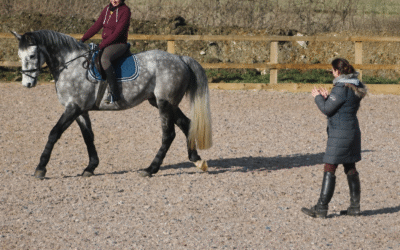
When you think of the traditional style of riding lesson, you might think of a coach/instructor standing in the middle of the arena shouting out instructions and corrections, this is what is referred to as explicit learning. Explicit learning is based on verbal instructions and step-by-step rules. It works well when you’re learning something new or fixing a clear technical problem. It gives structure and clarity.
But… there’s a catch.
When riders rely too much on verbal cues, especially under pressure, they often start overthinking, they start micromanaging their movement. That’s when skill can become tense and clunky, and mistakes can creep in.
Explicit learning is based on verbal instructions and step-by-step rules
What is implicit learning?
Implicit learning is the opposite, its learning without overthinking the details, without the reliance of explicit instruction. Implicit learning can come through a few different forms. Firstly, through errorless learning, where the difficulty of the task and environment is set in a way that minimises errors, allowing a rider to consolidate desired skill through practice. Secondly, a dual task approach can be adopted, using a cue word, or a count to distract the conscious brain from getting in the way of implicit learning. Finally, analogies can be used to direct focus to external effect rather than specific motor movements.
Why does this matter in competitions?
Because when you’re nervous, your brain loves to throw you off by over-controlling your movements.
Implicitly learned skills are more resistant to this kind of pressure. They live deeper in your nervous system, not in your conscious thinking brain. When things get stressful, implicitly learned skills keep running smoothly.
That’s why elite athletes in many sports use a mix of both types of learning but rely on implicit learning for competition performance.
when you’re nervous, your brain loves to throw you off by over-controlling your movements
So which approach is better?
Neither is “better” they just do different jobs.
Explicit learning is great for:
- Initial learning
- Clear technical corrections
- Theoretical understanding
Implicit learning is great for:
- Experienced riders
- Competition nerves
- Improving feel, timing, rhythm
- Fluency and harmony with the horse
- Reducing overthinking
- Making aids more automatic
Ultimately the best riders and coaches use a mixture of both, starting with explicit (the “what and why”) and moving toward implicit (the “feel and flow”) as the rider advances.


0 Comments