
“If you are pained by any external thing, it is not this thing that disturbs you, but your own judgement about it”
Marcus Aurelius
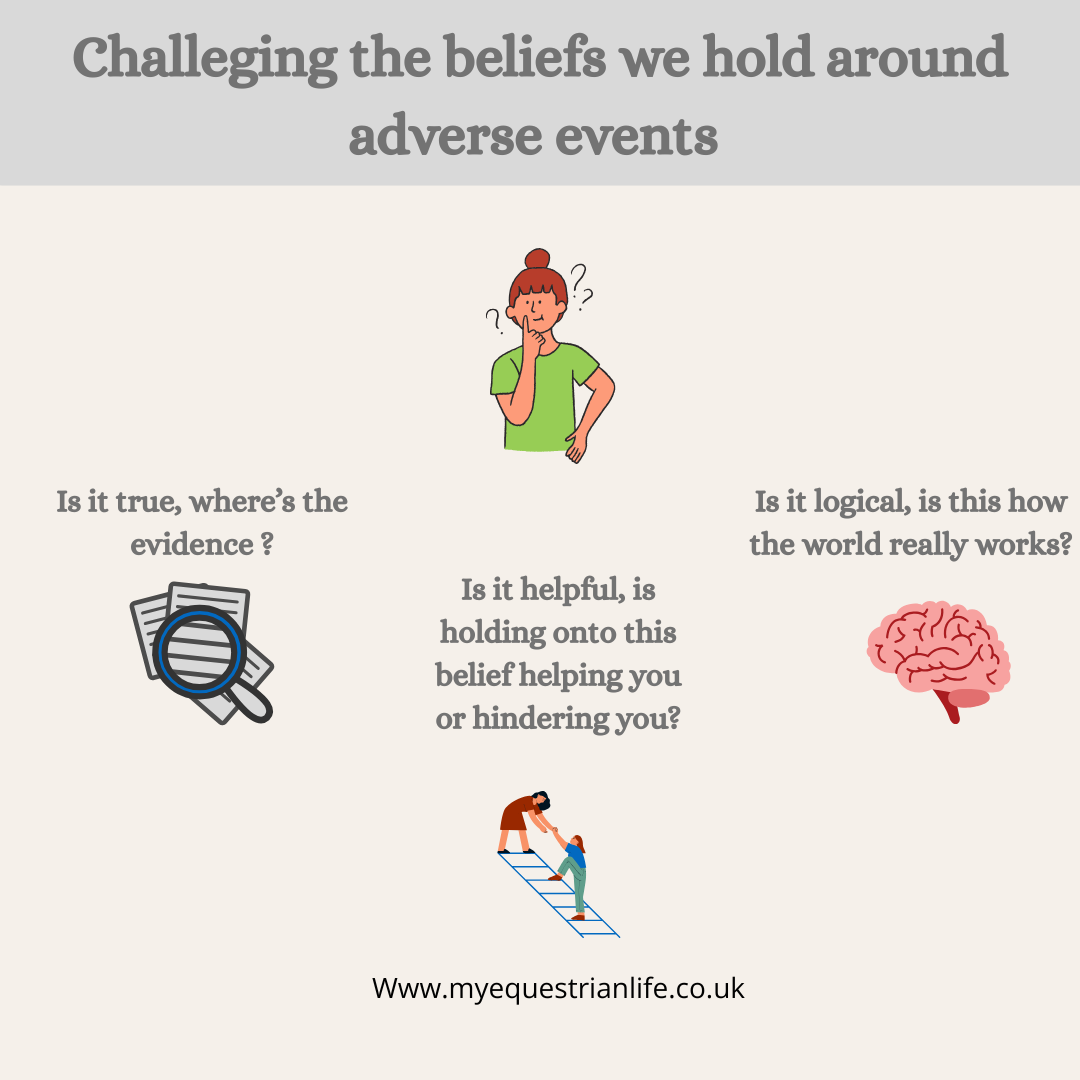
If you have a goal something you are working towards you will enviably face some adversity. We can’t achieve anything significant without there being some ups and downs. However, as this quote by Marcus Aurelius reminds us, it’s not the adverse event that that guides our behaviour but the beliefs we have around it. For example, we might say to ourselves ‘I did terribly in that dressage test, I’m obviously not good enough’ or ‘I’m not going to compete at that venue, everyone will think I’m not good enough to be there’. For this reason, it’s important that we develop an awareness of the beliefs we hold and if necessary challenge them. For this we can ask ourselves three questions;
Is it True?
Ask yourself: What evidence do I actually have that this belief is 100% true?
So many of our harsh self-statements are built on assumptions, not facts.
Example:
“I always mess up under pressure.”
Is that really true?
Probably not always. Maybe there were times you handled pressure well, but your brain filters those out because mistakes feel louder.
Try this:
- What proof supports this thought?
- What proof goes against it?
- Would someone else see this the same way?
Is it Logical?
Even if a belief feels true, it might not make sense.
Illogical thinking patterns, exaggerations, all-or-nothing language, and “must” or “should” statements that don’t reflect reality.
Example:
“I must ride perfectly, or it’s a disaster.”
Is that logical?
Not really. There’s no law of the universe saying perfection is required to have value or succeed. The belief exaggerates the consequences of imperfection and creates unnecessary pressure.
Try this:
- Does this belief follow a reasonable cause-and-effect pattern?
- Am I catastrophizing or overgeneralizing?
- Would I apply this same logic to a friend?
Is it Helpful?
Even if something is partly true and somewhat logical, it might still be unhelpful.
The question here isn’t “Is it nice?” — it’s “Does it help me move forward constructively?”
Example:
“I’m terrible at this.”
That belief might make you feel defeated, which saps motivation and confidence.
A more helpful alternative might be:
“That didn’t go how I wanted, but I can learn from it.”
One fuels growth; the other fuels self-doubt.
Try this:
- Does this thought motivate me or drain me?
- Is there a more helpful way to see this situation?
- What would a balanced belief sound like?
You can’t always control the thoughts that pop into your mind — but you can challenge the ones that hold you back.



0 Comments