
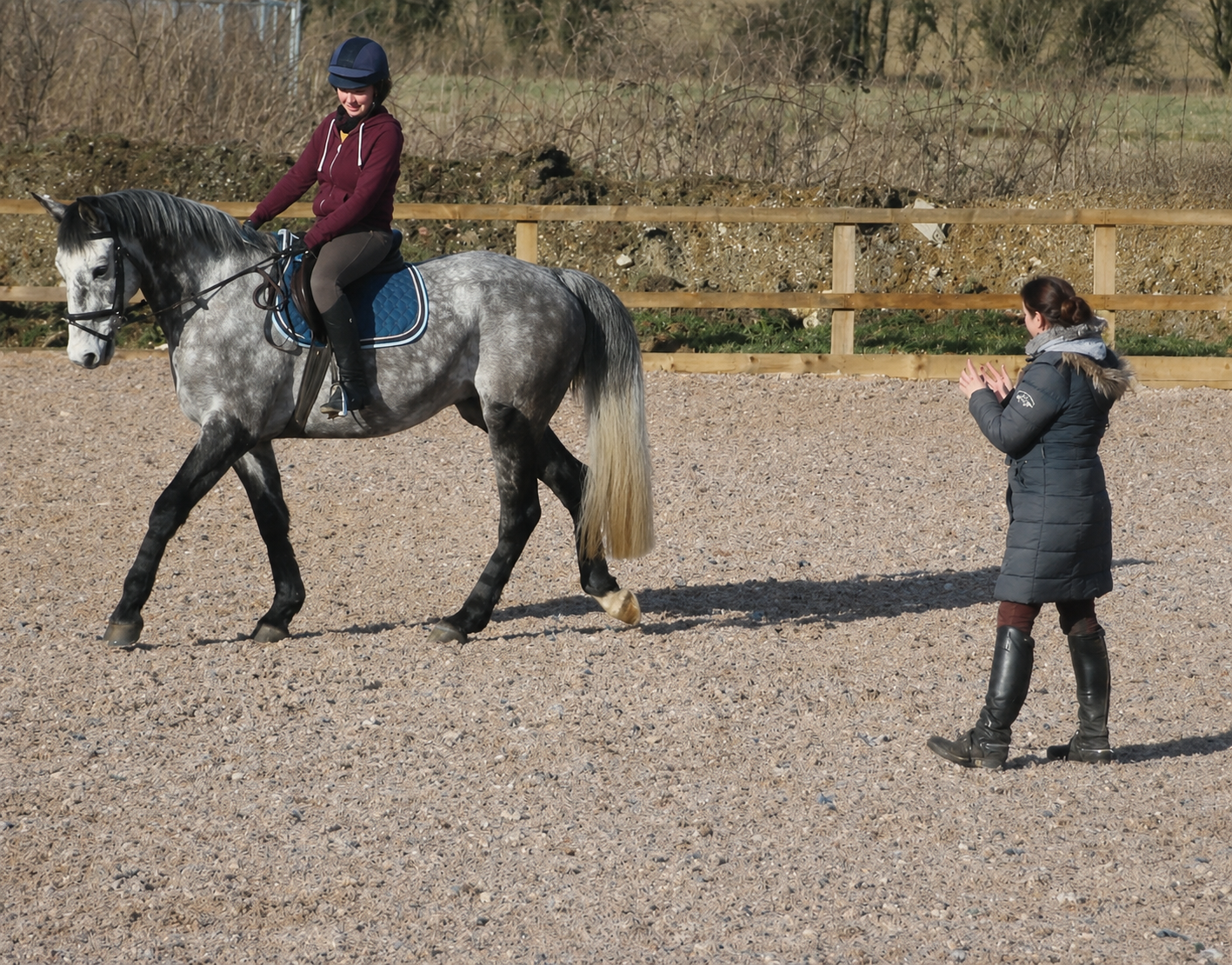
I think when people think of equestrian coaches, there is definitely a traditional stereotype: a scary, autocratic, not to be messed with kind of individual, with a booming voice and an ability to intimidate that is almost worn like a badge of honour. I think most of us riders will have come across this sort of person at some point in our horsey journey.
Like many of my peers, I have chosen to move in a different direction. I would describe my own coaching approach as conversational and collaborative. I remember Charles de Kunffy saying that in a lesson three individuals should be learning: the rider, the horse and the coach. This is something I agree with wholeheartedly. I appreciate that different riders respond to different coaching styles, but I have always found that if you are true to yourself as a coach, the right people tend to find you.
However, as part of my journey as a sports psychologist in training, I have learnt to step back and consider the role and impact of the coach from a more objective perspective. Recently, I found myself reflecting on an interesting question. While I think many of us would agree that an autonomy-supportive, positive approach to coaching may be better for rider wellbeing, is it also more effective when it comes to motor learning?
While I think many of us would agree that an autonomy-supportive, positive approach to coaching may be better for rider wellbeing, is it also more effective when it comes to motor learning?
Aggressive and autocratic coaching styles have often been associated with high standards and “getting results”. But is this style actually more effective when it comes to learning? Is there really a trade-off between mental wellbeing and performance?
I think we can begin to answer this question by looking at elements of Gabriele Wulf and Rebecca Lewthwaite’s OPTIMAL theory of motor learning (2016). Three points in particular stood out to me.
1. Enhanced expectations and autonomy support may contribute to efficient goal–action coupling by readying the motor system for task execution.
As a skill becomes more established, we become less reliant on consciously controlling every individual component of the movement. Instead, we establish an intention or goal and allow the motor system to organise the movement required to achieve it.
Wulf and Lewthwaite propose that enhanced expectations for successful performance and a sense of autonomy can strengthen this relationship between intention and action. In practical terms, if a rider believes they are capable of successfully executing a skill and feels that they have some ownership over their performance, they may be better placed to translate their intended movement goal into action efficiently.
This raises an interesting question for us as coaches: could a coaching environment that develops a rider’s self-belief and autonomy actually help create better conditions for motor learning?
This raises an interesting question for us as coaches: could a coaching environment that develops a rider’s self-belief and autonomy actually help create better conditions for motor learning?
2. Conditions that enhance expectations for positive outcomes may trigger dopaminergic responses that benefit motor performance and learning.
Motor learning involves strengthening and refining neural pathways as we practise and experience the consequences of our movements. Wulf and Lewthwaite discuss dopamine as one potential mechanism through which positive expectancies and successful experiences may influence learning, particularly through processes associated with motivation, reward and memory consolidation.
This is particularly interesting from a coaching perspective. If the way we communicate influences a rider’s expectations of success, then perhaps our words are doing more than simply making someone “feel good”. They may contribute to a motivational state that is more conducive to learning.
This doesn’t mean that every mistake needs to be praised or that coaches should avoid corrective feedback. Rather, it raises the question of whether we can maintain high standards while communicating in a way that preserves the rider’s belief that improvement and success are possible.
3. Autonomy, enhanced expectations and an external focus may allow movement to be controlled more automatically.
The third element of OPTIMAL theory that interested me was attentional focus. Research suggests that motor skills are often performed and learnt more effectively when attention is directed externally towards the intended effect of the movement rather than internally towards controlling individual body movements.
This makes me think about what happens when a rider feels intimidated, judged or frightened of making a mistake. Rather than simply responding to the task in front of them, they may begin consciously monitoring and controlling their own performance: Where are my hands? What are my legs doing? Am I doing this wrong? What is my coach going to say?
For an experienced rider in particular, this increased conscious control could potentially interfere with movements that would otherwise operate relatively automatically.
So perhaps the question isn’t whether supportive coaching means lowering standards. Perhaps it is about creating an environment in which riders can meet high standards without unnecessary fear, self-consciousness or loss of autonomy getting in the way of learning.
I appreciate that I am approaching this question as a coach who already favours an autonomy-supportive, encouraging style. However, I think the research gives us some interesting food for thought.
If aggressive or controlling coaching is defended on the basis that it “gets results”, perhaps we need to ask a different question: does it get results because of the coaching style, or do riders sometimes achieve results despite it?
If aggressive or controlling coaching is defended on the basis that it “gets results”, perhaps we need to ask a different question: does it get results because of the coaching style, or do riders sometimes achieve results despite it?
Maybe supporting rider wellbeing and promoting effective learning don’t have to be competing priorities after all.
I would love to hear your thoughts.



0 Comments